








RSR Pro 1000 PSI Turbo Water Injection
It's the pumps.
It's always the pumps. They can never be too small or too
powerful, or, as they say, too rich or too thin. Usually
they are fat and noisy or small and pitiful in their output.
When they are fat and noisy and only come in one size they,
most likely, are diaphragm pumps that crawled out of bilges
on boats or escaped from agricultural spray systems.
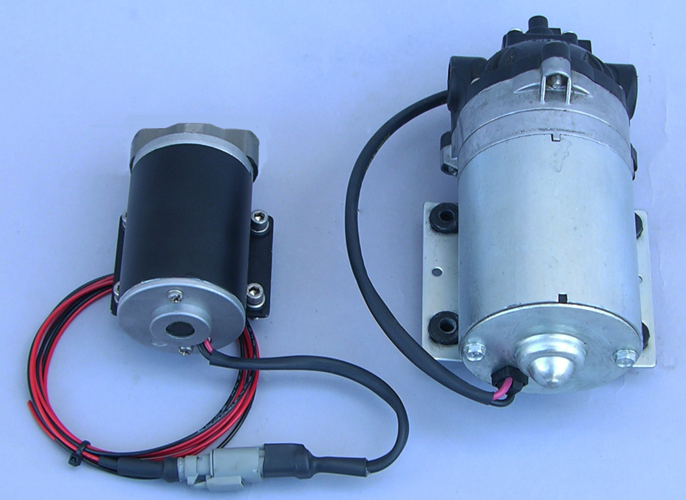
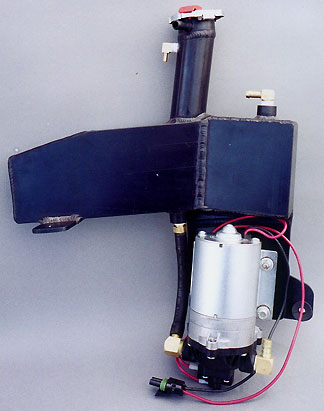
Our high pressure pump pictured
above to the left is small, is 1/3 the weight, and runs up
to six times the pressure of the typical water injection
kit pump pictured on the right. Higher pressures means far
better atomization. It draws less that 3 amps @ 1000 psi.
Before we show you how we do
this you need to know a bit about water injection's
history and about RB Racing's history using water
injection. Part numbers and pricing are listed below.
Part Numbers, Flow and Horsepower Ratings & Number
of Nozzles
RSR Pro
1000 PSI
Water Injection System
|
Description
|
Nozzles 90 degree
1/4" NPT
|
Hardware: Note: Does not
include any reservoir.
|
2500 PSI Hose
|
Price
|
03-1001
|
160cc's / minute
300 hp:
12% Water to Fuel Ratio
1000 psi operation
Dual Nozzles
3.5 Amp electrical load
|
Two (2) "B"
Nozzles with anti-vacuum
valve and filter
90 degree 1/4" NPT
|
Pump; hose fittings; 30A
Relay;
Hobbs Pressure Switch; On/Off Switch; Wiring; LED
acivation light; Two B nozzles. |
8 feet 2500 psi hose
|
$695.00
|
03-1002
|
180cc's / minute
350 hp:
12% Water to Fuel Ratio
1100 psi operation
One Nozzle
3 Amp electrical load
|
One (1) "D"
Nozzle with anti-vacuum
valve and filter
90 degree 1/4" NPT
|
Pump; hose fittings; 30A
Relay;
Hobbs Pressure Switch; On/Off Switch; Wiring; LED
acivation light; One D nozzle |
8 feet 2500 psi hose
|
$650.00
|
03-1003
|
180cc's / minute
350 hp:
12% Water to Fuel Ratio
1000 psi operation
Dual Nozzles
4.0 Amp electrical load
|
Two (2) "A"
Nozzles with anti-vacuum
valve and filter
90 degree 1/4" NPT
|
Pump; hose fittings; 30A
Relay;
Hobbs Pressure Switch; On/Off Switch; Wiring; LED
acivation light; Two A nozzles. |
8 feet 2500 psi hose
|
$695.00
|
03-1004
|
200cc's / minute
375hp:
12% Water to Fuel Ratio
780 psi operation
Dual Nozzle
3.0 Amp electrical load
|
Two (2) "C"
Nozzles with anti-vacuum
valve and filter
90 degree 1/4" NPT
|
Pump; hose fittings; 30A
Relay;
Hobbs Pressure Switch; On/Off Switch; Wiring; Two C
nozzles.
|
12 feet 2500 psi hose
|
$695.00
|
03-1005
|
210cc's / minute
400 hp:
12% Water to Fuel Ratio
720 psi operation
Triple Nozzle
3.0 Amp electrical load |
Three (3) "A"
Nozzles with anti-vacuum
valve and filter
90 degree 1/4" NPT
|
Pump; hose fittings; 30A
Relay;
Hobbs Pressure Switch; On/Off Switch; Wiring; LED
acivation light; Three A nozzles
|
8 feet 2500 psi hose |
$725.00
|
03-1006
|
240cc's / minute
450 hp:
12% Water to Fuel Ratio
600 psi operation
Dual Nozzles
2.0 Amp electrical load |
Two (2) "D"
Nozzles with anti-vacuum
valve and filter
90 degree 1/4" NPT
|
Pump; hose fittings; 30A
Relay;
Hobbs Pressure Switch; On/Off Switch; Wiring; LED
acivation light; Two D nozzles.
|
8 feet 2500 psi hose |
$695.00
|
03-1007
|
260cc's / minute
495 hp:
12% Water to Fuel Ratio
520 psi operation
One Nozzle
1.75 Amp electrical load |
One (1) "E"
Nozzle with anti-vacuum
valve and filter
90 degree 1/4" NPT
|
Pump; hose fittings; 30A
Relay;
Hobbs Pressure Switch; On/Off Switch; Wiring; LED
acivation light; One E nozzle.
|
8 feet 2500 psi hose |
$650.00
|
03-1008
|
280cc's / minute
525 hp:
12% Water to Fuel Ratio
340 psi operation
One Nozzle
1.0 Amp electrical load |
One (1) "G"
Nozzle with anti-vacuum
valve and filter
90 degree 1/4" NPT
|
Pump; hose fittings; 30A
Relay;
Hobbs Pressure Switch; On/Off Switch; Wiring; LED
acivation light; One G nozzle.
|
8 feet 2500 psi hose |
$650.00
|
03-1009
|
280cc's / minute
525 hp:
12% Water to Fuel Ratio
220 psi operation
Dual Nozzles
1.5 Amp electrical load |
Two (2) "E"
Nozzles with anti-vacuum
valve and filter
90 degree 1/4" NPT
|
Pump; hose fittings; 30A
Relay;
Hobbs Pressure Switch; On/Off Switch; Wiring; LED
acivation light; Two E nozzles.
|
8 feet 2500 psi hose |
$695.00
|
03-1010
|
300cc's / minute
560 hp:
12% Water to Fuel Ratio
160 psi operation
Dual Nozzles
1.0 Amp electrical load |
Two (2) "F"
Nozzles with anti-vacuum
valve and filter
90 degree 1/4" NPT
|
Pump; hose fittings; 30A
Relay;
Hobbs Pressure Switch; On/Off Switch; Wiring; LED
acivation light; Two F nozzles.
|
8 feet 2500 psi hose |
$695.00
|
03-1011
|
Weld-On Aluminum Nozzle
Boss; Counterbored for flush interior capture of nozzle.
|
For All Nozzles
|
Requires a .750" hole be
machined on the mating surface
|
1" Overall Length
.875" Diameter w/ .750" diameter step .125" deep
|
$15.00
|
RB Racing: Art and Science 1998
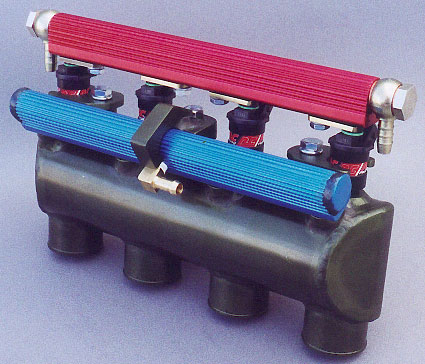
The blue rail of this BMW K1200RS/GT/LT Turbo
Plenum is a port water injection system with four nozzles.
Water Injection is the best way to make power when you are
dealing with forced induction systems. In this case we are
running a turbo on a 11.5:1 high compression bike and doubling
the horsepower with reliability. There is really nothing new
about this...We've been doing it for nearly 30 years but
people were doing it way, way, before we ever came on the
scene.
The red rail is the secondary fuel injectors.
You end up with eight fuel injectors and four water injection
nozzles on a 1200cc motorcycle. More holes than Swiss cheese.
Hard anodized inlet plenum. Later on, when we ran a series of
tests, we decided that the port nozzle design wasn't a good
idea as there was a slight variation in flow rates...little
consistency.
12
O’Clock High: Six Decades Earlier 
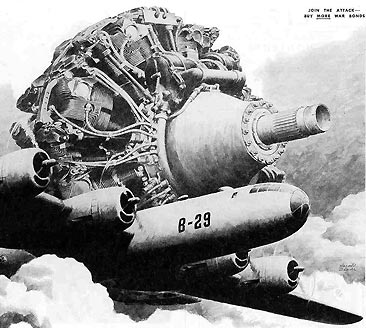
Sir Harry Ricardo and the High Speed Aero
Engine. Incredibly complex, turbo-supercharged, radial and
V-12 engines that had to take off with a full bomb load in
conditions that were never ideal. You might think you put the
pedal to the metal but, for the WWII fighter and bomber crews,
death was always part of equation...It wasn’t a game and if
you couldn’t squeeze out the last bit of horsepower you were
dead. It was in this environment that water alcohol injection
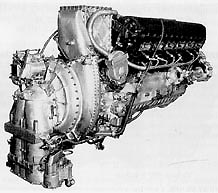
technology was refined. Wright Cyclone engine pictured above.
Nothing has changed except the passage of time.
The pioneering research was done by people like Sir Harry
Ricardo, the researchers at NACA in Langley Field and all the
aero engine designers of the period entering the Second World
War. Give credit where it’s due and don’t think the sun only
started rising yesterday. Rolls Royce Merlin engine pictured
above.
For an interesting read you can download a PDF from NACA dated 15
August 1942. It still applies today. A second NACA PDF also validates
the use of water injection.
Papa’s Got a Brand New Bag
Colorful 3D ribbon graphs, literature full of
mumbo jumbo, and electronic controls full of potentiometers
and blinking lights some 60 years later is nothing but a new
box to hide a heritage born in the skies over Europe. People
want you to believe that they invented water...well, people
spend billions of dollars to buy brand name designer water in
trendy plastic bottles that end up in the ocean and land
fills, so anything is possible in today’s gadget-filled world.
It’s a brave new world but to paraphrase a popular political
phrase..."It’s the water Stupid!". If you want your high
output turbo or supercharged motor to avoid engine destroying
pre-ignition and detonation you are going to have to employ
water injection and the way it has to be done was set in stone
a long, long, time ago.
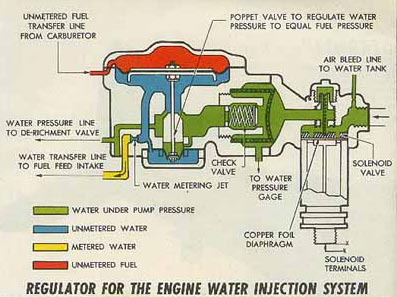
Pictured above is a schematic of a WWII aero
engine water/methanol regulator...designed over 60 years ago!
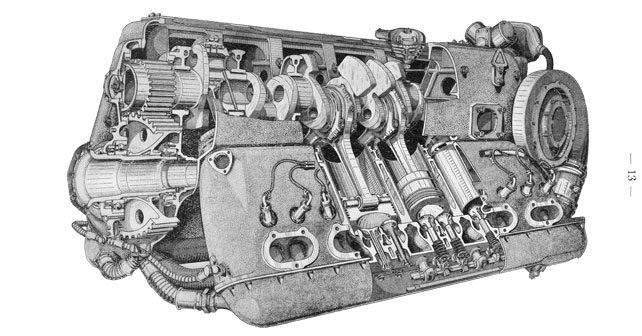
Water and methanol – this is the composition
that BMW concocted in the 1940’s to increase the performance
of its 801 aircraft engine – a 14-cylinder that produced
2,000hp. Daimler-Benz did the same with the 605 V12 (used by
Messerschmitt aircraft) that used 90-octane petrol and rode
the MW50 system, which injected fuel and a mixture composed of
50% water and 50% methanol into the cylinders. That solution,
in addition to ensuring a high antiknock, helped to avoid the
risk of ice formation at high altitude. A similar system was
adopted for the R-2800 18-cylinder of the American Company
Pratt & Whitney.
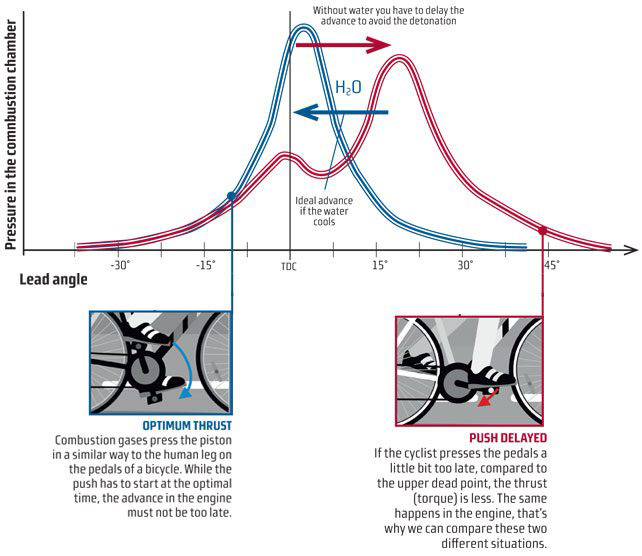
The torque output of a
motor is the result of the thrust exerted on the piston crown,
which depends on the pressure reached during the combustion
phase in the cylinders. The cooling produced by the water
injected into the combustion chambers runs the risk of
detonation (which would damage the piston and the head)
allowing engineers to avoid delaying the advance angle of the
air-fuel mixture with respect to the optimal value (which is
the time where the first spark happens) – with the advantage
of obtaining a higher combustion pressure. In other words,
achieving a higher driving torque...with higher boost.
Monster Marine Diesels
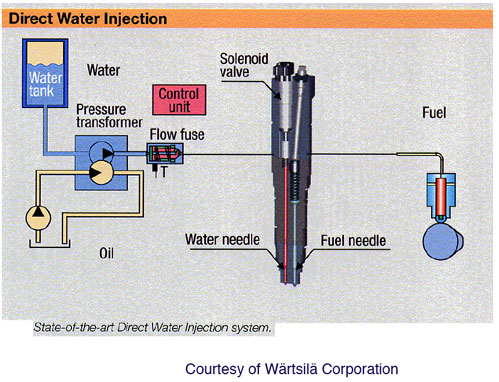
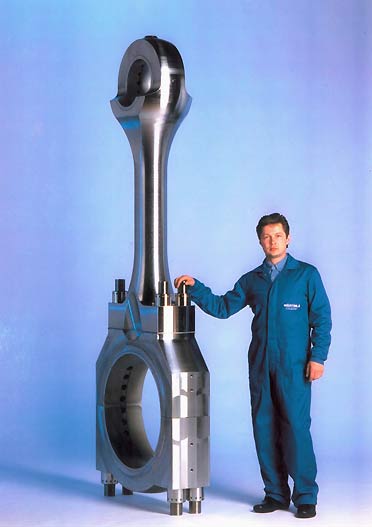
Engines bigger than your house and they use
water injection to reduce emissions! Diesel engines obviously
can derive some benefit from cooling the combustion process.
This is really big industrial stuff so don't think about
adapting anything. The company is Wartsila. If you're a
diesel junkie these things are the pyramids.
Sex Boost Rock
& Roll...The Formula 1 Era
It's 1987 and in your dreams you have your FOCA
pass and a long-legged, high cheekboned bird of paradise has
her tongue in your ear and her hand in your Nomex on the
biggest yacht in Monaco's harbor. The shrimp cocktails and the
fine wines flow and you've just qualified on the front row
with your 800 hp turbocharged F1 missile. All abs and no flab,
not a love handle or a stretch mark in sight, and your eyes
focus like a Peregrine Falcon in a 200 mph dive. Wake up fool!
You're wearing glasses, baggy shirts are covering your love
handles and you're seeking status and approval from other
idiots and you sure aren't in Monaco.
Time for us to reflect on the big boys, what
was, learn a few things, and then slink back to our pitiful
existence. Monday to Friday trying to pay the bills and
seeking meaning through our toys.

Renault started it all in 1977. They always
start it all. First with turbos, first with pneumatic valves,
first to use water injection, first with a lot of things.
Heavy thinkers, great engineers, Ecole Polytechnique. Think R5
Turbo. In 1983 the F1 Renault showed up with a 12 liter water
tank, an electric pump and pressure regulator and about 600 hp
from 90 cubic inches. By 1986 the power had been increased to
870hp but the water injection was gone as the fuels had
improved.
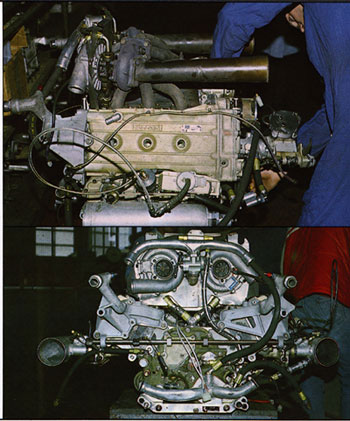
In 1983 Ferrari also claimed to be the first to
use water injection. With the cooperation of their fuel
supplier Agip they managed to suspend water in the fuel in
microscopic emulsified drops in a ratio of 90% gasoline and
10% water. They won the constructors championship. Like
Renault they dropped water injection when heavier fuel
elements (toluene) came into use.
Porsche and, later on, Honda showed up and
cleaned house to the point where turbos were banned. Honda
relied on a mixture of 84% toluene and 16% heptane and ran up
to 58 psi of boost to achieve up to 1000 hp. Honda did not use
water injection.
Don’t Drink the Purple Cool-Aid
Turbo gurus, blindly following false prophets,
preach the doctrine of "You Can’t Run Them Too Rich" and
demand that you slay the infidel detonation by richening
things ad infinitum. They should have read Sir Harry’s Book, The
High
Speed Internal Combustion Engine, but as they say, those
who do not know history are destined to repeat the same
mistakes. Sir Harry Ricardo proved once and for all that you
can richen things up to a point but, beyond this, detonation
is going to rear it’s head no matter how much fuel you throw
at it and, in fact, the extra fuel may increase the tendency
to detonate! Going rich beyond the well-defined 12.5:1 boost
maximum power air fuel ratio is going to cost you power.
Studies in the early part of the Second World
War proved conclusively that as you add water you can lean out
your overly rich mixtures as you raise your boost pressures.
As Sir Harry Ricardo stated..."By the introduction of
water...the fuel/air ratio could be reduced once again; in
fact, with water injection, no appreciable advantage was found
from the use of an over-rich fuel/air mixture". So much for those whose perspective begins with their
birth date.
I Don’t Want
To Learn...Just Give Me The Answers!

1. Maximum Torque occurs at a 13.2:1 Air Fuel
Ratio.
2. Transitional Fueling and Maximum Boost Air Fuel Ratios are
about 12.5:1.
3. Water Injection is most efficient with a 50/50 water
alcohol (or methanol) mixture.
4. Methanol, as an additive, is not a practical choice as it
is prone to pre-ignition in higher than 50/50 percentages, is
not safe to handle, and is not readily available. It's a good
choice, but not necessarily the most practical one when you
need some in a hurry. Methanol is usually found where racing
fuels are sold.
5. Denatured (ethanol) alcohol, typically 95% pure, is
available in paint, hardware, and Home Depot type stores in
gallon containers for about $10.00. Expensive but available
everywhere. Isopropyl alcohol can be used but it is often 30%
or more water by content.
6. Water Injection allows ignition timing to be more
aggressive or closer to stock. In other words boost does not
automatically mean retard your timing.
7. Excessive amounts of ignition retard will cause a loss of
power and overheating.
8. Water to Fuel ratios should be based on weight and not
volume.
9 . Water weighs 8.33 lb per gallon.
10. Alcohol weighs 6.63 lb per gallon.
11. Air weighs .080645 lb per cubic foot. It takes about 150
cubic feet of air per 100 horsepower. It takes about 12 lb of
air per 100 horsepower.
12. Water or Water / Alcohol to Fuel Ratios are between 12.5%
to 25%. This means Air to Fluid Ratios are between 11.1:1 and
10.0:1 with water injection.
13. Maximum water delivery should be in higher load low to mid
rpm ranges tapering somewhat at peak rpms where load is less.
14. Atomization of the water mixture is directly related to it
effectiveness. Finer droplets cool the inlet charge better and
with less mass they navigate the inlet plenum easier for more
equal water distribution.
15. Don’t flow water through an intercooler.
16. Atomized water, just like fuel, does not like to make
turns thus making accurate distribution something to think
about. This is why port fuel injection is the norm. Water is a
fluid just like your fuel. Using high pressures up to 1000psi for the best atomization and even
distribution. Using individual port nozzles is a bit
complicated for a large # of cylinders and makes control
difficult as nozzles vary in their output.
17. The introduction of water will allow higher boost
pressures to be run without detonation. Higher pressures will
increase torque. It’s always about torque.
18. Racing high octane gasoline should be used for all forms
of competition and for higher than normal boost levels. Water
injection as well as charge cooling should be used with racing
gas. 91/92 Octane pump gas simply will not cut it. Water spray
cooling of the intercooler is a good idea.
19. Fuel Injectors operate in the 1 Millisecond range (.001
second) and are not capable of long term usage for H20 as they
will corrode or rust shut in a very short period of time.
Unless a solenoid can open as fast as a fuel injector it
should not be used to "pulse" water injection events as flow
is not directly related to "duty cycle".
20. Varying voltage to water injection pumps or using similar
schemes is a recipe for disaster. You have to eliminate the
variables, not increase them.
21. Fuel Injection pumps cannot be used for water injection.
Water is conductive. Gasoline is not. Water will corrode an
efi pump shut in a very short period of time.
22. Water injection has a cooling effect on the engine head,
valves, and cylinder. Exhaust temperatures (EGT) are largely
unaffected at recommended water / fuel ratios.
23. The cooling of potential hot spots in the combustion
chamber defeats pre-ignition, the most destructive form of
uncontrolled or unplanned combustion.
24. Higher static compression ratios will require a higher
percentage of water or water / alcohol.
25. No, water does not burn. We are not combusting the
hydrogen in the H2O.
26. At around 13.2:1 or fuel air ratios of .75, EGT’s will
peak.
27. People will try to selectively edit their way to get you
to use water injection by stating "One can basically double
the power output of an engine using water/methanol" and "It
was used effectively in Formula 1 before being banned for
adding too much power". This is pure bunk. Water or
water/alcohol/methanol does not make power...superchargers and
turbochargers make power. The cooling effect of the water
injection only allows you to run higher boost pressures and
leaner mixtures without engine damage. The increased density
or higher pressure ratio is what makes the power, not the
water. The last time we checked water wasn't a very good fuel.
Water Injection definitely does not give "a 5-15% increase in
fuel economy" as some marketers clain.
28. Ferrari suspended water in their fuel during
their 1980’s Formula1 period. We don’t recommend that you try
this...although Acetone will mix with water.
Running Water Injection since
1980
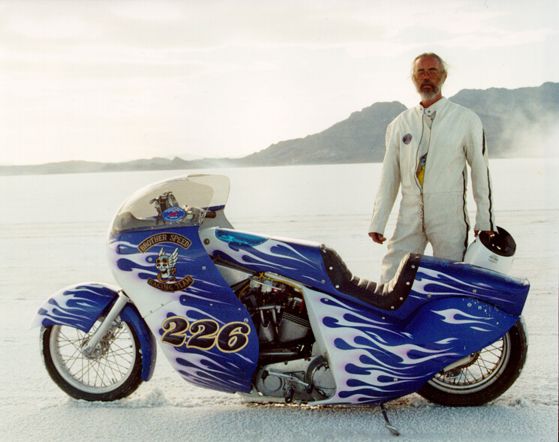
Harley-Davidson, Suzuki, BMW, Hondas, Kawasakis,
Triumphs etc....all our race bikes have run water injection
since the early 1980's. The thermal loads, even with
intercooling and racing gasoline are too high and without
water injection you simply can't run mile after mile on the
long course at Bonneville without some additional form of
charge cooling. Running 22 psi of boost between the two mile
and four mile markers day after day and no engine failures.
Mike Geokan's famous #226 Blue Bike and his new Bonneville Bullet use RSR Water
Injection.
Nearly 30 years of water injection and turbos.
We have been in the high performance business since the late 1970's.
Water Injection History at RB Racing
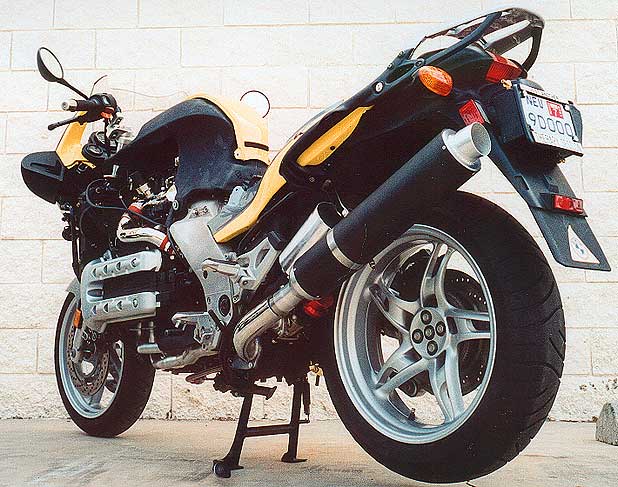
Early Systems:
Way back around 1980 and a few times later on we did not
even use pumps. We simply used boost pressure to push water
into the engine through a small nozzle. What we would do was
hard anodize an aluminum water container designed to be
bolted to a specific location or in some cases to be
collocated with the license plate at the rear of the bike
(see above photo). We machined up o-ring sealed screw-on
caps. The hard anodization was to prevent corrosion from
water, methanol, or alcohol mixtures. We would employ a
viton sealed check valve with a specific cracking pressure,
typically around 5 psi, and flow the water through a small
jet, usually .6mm, into the turbo inlet. You could not flow
the water after the turbo as there would be no pressure
differential. Flowing water through the turbo could cause
problems with throttle shafts, mass flow sensors (LE
Jetronic) and had a tendency to corrode any pot metal
structures. We made hundreds of such systems on carbureted
turbo kits for many different kinds of bikes.
Early K1200 turbo with water
reservoir under license plate.
Next Step In Our Efforts:
In the late 1980's and through the mid 90's we went to
intercooled systems both with blow-through carburetors and
from 1989 on with our RSR Fuel
Injection systems. You cannot flow water though an
intercooler and based on our earlier efforts we wanted to
inject water after the turbo and not into the turbo. We sort
of went a radical direction that meant that things were no
longer practical but, what the hell, you have to win races
and set records. If you are running for six wide open miles
at Bonneville you must know exactly how much water is going
into your engine. We did, and we never lost an engine.
What we did was use hard-anodized
water reservoirs, fuel injection pumps, fuel injection
pressure regulators and actual fuel injectors to deliver
water, all under RSR EFi
control. The problem with this is water will kill fuel
injectors, rusting them shut, even if left overnight. Water
is conductive, gasoline is not. Gasoline has lubricity,
water does not. Fuel injection pumps will rust shut and die
if water is run over an extended period. We would race at
Bonneville during the day. At the end of each day we would
drain the tank, pull the water injectors, and flush the
system with WD40 and gasoline. The next day we would put in
new water, get the water inspected, and have the container
sealed by tech officials so we could stay in the gasoline
class. It was a big hassle. Safety wire pokes holes in your
fingers. Blood is slippery.
People used to ask us to
duplicate these systems for them and we refused because it
was too costly, too labor intensive, and when we let other
people run the bikes they did zero maintenance and the
systems rusted shut and failed. Usually they would detonate
and blow the porcelain off of a spark plug when the water
injectors would not open. We got tired of baby-sitting our
systems for non-appreciative glory seekers.
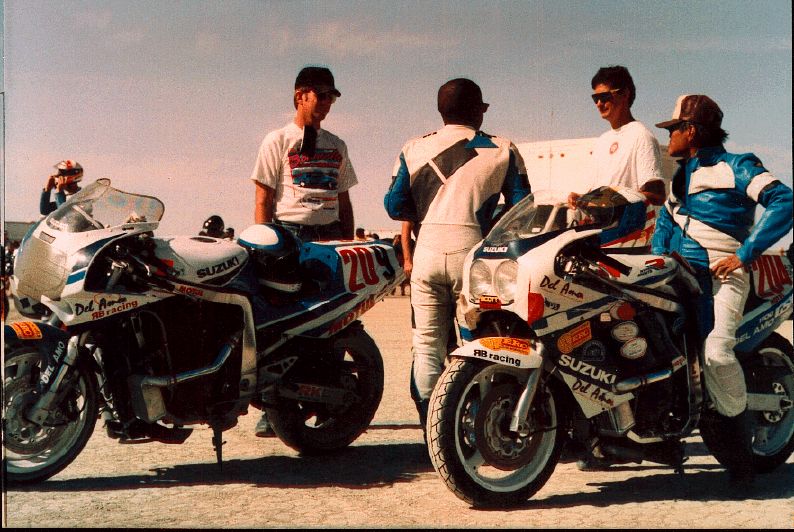
Two Suzuki GSXR RB Racing Turbos.
RSR Fuel Injected, intercooled and water injected. E-Ticket
to El Mirage and Bonneville 200 mph clubs.
Clunky Period:
To get away from the labor intensive efi pump systems we
tested some commercial Shurflo and Flojet water pumps.
They were heavy, had large 3/8 NPT and 1/2 NPT fittings,
and non-waterproof spade electrical connectors. They were,
however, designed to pump water, could be operated "dry"
without damage, and did not rust shut. Some alcohol or
methanol variations would eat the plastic components.
Pictured above is a Shurflo
pump we tested on a BMW K1200RS. It wasn't really elegant
but it did work and we had to invent a regulator to keep
the flow constant as it did not have an internal bypass
circuit. Its large size makes it serious packaging problem
on a motorcycle. After some testing we got rid of the
clunky pump.
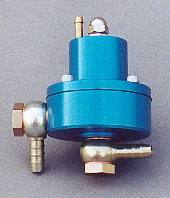
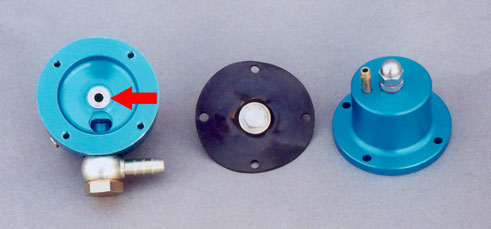
These are the billet regulators we machined
up with Titanium seats and double nitrile diaphragms for
testing. The Shurflo RV pump would bypass water from the
regulator back to the anodized reservoir and the boost
pressure was referenced to the upper part of the diaphragm
to keep the water pressure constant. More complication.
They were pretty things. The lure of billet parts, the
siren call. Don't ask us for one. We don't make them
anymore.
Hose Tech
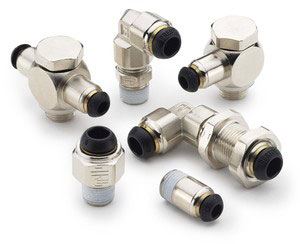
Since we have about 35 years experience with
carburetors, fuel injection and water injection, we have
used about every type of hose and fitting you can think of.
In fact, way back in 1980, we used some of the first "push
to connect" fittings (Alkon)
on air shifters that we used to make. Virtually all water
injection sellers use these type of O-ring fittings as they
are easy to work with. Measure, cut, push, done. The problem
we have with these is they aren't rated for our 1000 psi
pumps.
We use high pressure compression fittings and
2500 psi hose. We cover the hose with 1200 Deg F fiberglass
sleeving for flame and abraision protection.
Water Reservoirs and
Calculations
You're on you own here. There are all sorts of
windshield washer bottles, radiator overflow tanks and
fabricated assemblies that you can figure out on your own.
Poke around and you can find about anything in an autoparts
store. Too complicated for us. We tried dealing with a few
companies like Flambeau but it was a complete waste of time
as we won't compromise and we positively hate clunky generic
crap.You mess with it...engineer your own.
For your calculation purposes: 3785cc/gallon.
If you use the 03-1001 330 hp System (180cc/min) you have
about 20 minutes of operation per gallon i.e. 3785/180=21.02
minutes...or a quart every 5 minutes of operation. At 330 hp
the water to fuel ratio is 12%...more at lower boost
activation points. On the safe side call it 15 minutes.
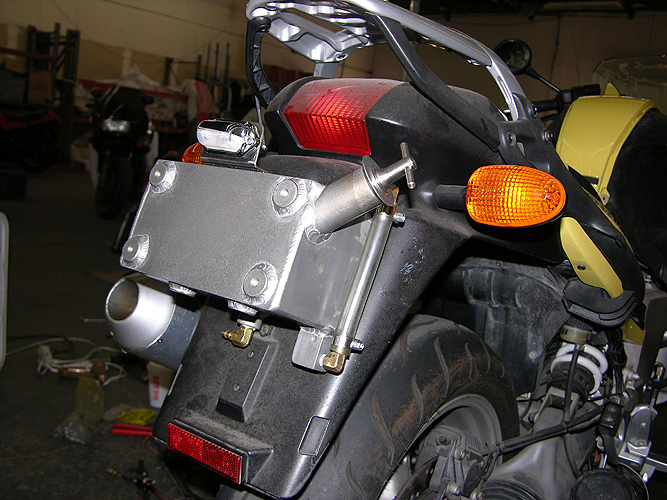
This is a reservoir we fabricated for our BMW
and Harley Davidson Turbocharger
systems. It bolted to the license plate mounting points with
blind holes hold the license plate. A clear hose provided a
liquid level site gauge. Hardcoat Anodization is used to
protect against water/alcohol corrosion. Motorcycles do not
have "engine compartments" and space is at a premium.
Expensive and time consuming to make.
We got religion after making a number of these
and switched to molded plastic tanks.
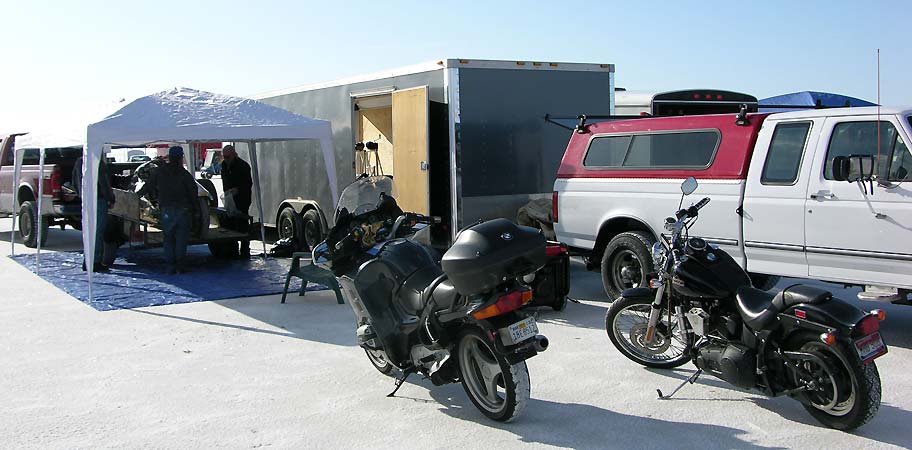
Here, mounted on a BMW R1100RT Turbo, the water
injection was used on a 2000 mile test riding to the
Bonneville Salt Flats where we were racing the Bonneville
Bullett. Running pump gas the bike did not detonate up to 15
psi with a 10.7:1 compression ratio. Above this race gas is
called for. We ran two small nozzles to cover the 240 hp.
Don't try to pass semis in the midle of nowhere at 150
mph...we did and don't recommend it.
RSR
Water Injection Pump Tech
Basic Calculations:
We have to plan our pump design, quite logically, on the
required delivery of water or water-alcohol mixtures to
our target. Take a simple hypothetical situation of 300
horsepower which, at a B.S.F.C. of .5 lb per horsepower
per hour (150 lbs of fuel)...which equates to about
22.62 gallons of gasoline per hour (150lbs / 6.63 lbs
per gallon = 22.62). If we are trying for 15% of the
mass using 100% water the 15% is .15 x 150 = 22.5 lbs of
water per hour.
22.5 lbs water / 8.33 lb per
gallon = 2.7 gallons per hour water consumption. To
calculate cc's we multiply 2.7 x 3785cc per gallon =
10,219 cc's. To calculate the cc's/minute of water
needed we to divide by 60 which gives us 170cc's per
minute.
We used the same planning
when we were using actual fuel injectors to deliver
water at Bonneville.
Design Quandary:
This brings us to an interesting conclusion concerning
the water pumps people use for water injection systems.
Companies like Snow Performance and others use Shurflo
diaphragm water pumps that were designed for
agricultural, recreational vehicle (RV), marine, or
industrial fluid transfer situations. These pumps are
rated in the range of 1.4 to 3 gallons per minute
which is way, way, beyond the 2.7 gallons per hour
of water we need for the hypothetical 15% contribution
to 300hp. If you remember we only need 170cc per minute
of water for 300 horsepower. The Shurflo pumps push out
around 8000 to
19,000 cc's per minute. Actually
there is no penalty for wretched excess but do you
really need a 5 or 6 pound bilge pump to deliver 170cc's
per minute?
It's pretty easy to see that
these diaphragm pumps are not really the best pump
design for water injection. They are big, clunky, heavy
and are designed with 3/8 NPT and 1/2 NPT fittings. Just
the thing for an RV sink but hardly the best pump for a
water injection system. They are cheap and they do pump
water reliably.
Another thing they do not
tell you is that the rated presures, say 150 psi,
are not consistent. Don't even think about pulse width
modulating slow solenoids to control water flow. At 150
psi with fluctuating pressures the atomization is
incosistent.
Considerations of Pump Design
1. Diaphragm Pump Motor Design: The
solution to this problem is defined by the problem:
Water is corrosive, has poor lubricity, and must be
isolated from the pump motor. The best way to do this,
with some caveats, is to separate the pumping
mechanism and the pump motor. Diaphragms, pistons,
gears, swash plates, magnetic drives are all on the
table.
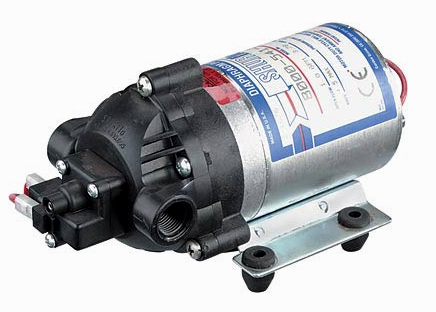
Shurflo diaphragm pumps (usually model
8000, 8030 or similar) are used by firms and private
individuals like Alcohol
Injection
Sytems, AEM,
Snow Performance, Devils Own,
and probably about 50 others . These pumps are all
about 5 to 7 pounds in weight and about 8.5" to 10" in
length. These are not magnetic drive units. A number
of DIY water injections use these type of pumps. Even
Aquamist offers a Shurflo unit for about $900.00. They
all claim or aim for the highest pressure
rating...None are anywhere near commercial misting
pressure ratings.
These guys all say they are better than
the other guy and they seem to like to try to sue each
other out of business. It's just a packaging buisness.
We have an electronics acquaintence who was asked to
design a control module for one of these firms...The
target was a cost not more than $25.00 to$30.00, they
would not pay for the design time, and it would have a
retail of $200.00. Like we said...it's a packaging
buisness.
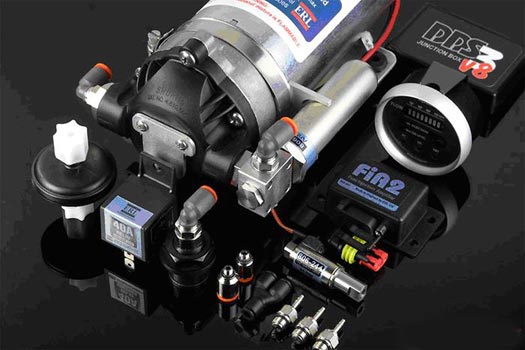
People make businesses out of packaging
these parts. It's nothing new and just an easy way to
put some parts in a box without having to engineer out
a custom product like the older magnetic drive
solenoid Aquamist solution. Greed is good. If you are
running a ton of boost in a Diesel they are a good
choice as some models will put out 150 to 250 psi as
diesels can run 40 psi or more manifiold pressure.. No
one uses regulators like we did
at Bonneville. Some use internal
bypass ...These are just on/off and deadhead at the
nozzles and solenoids. They are also very loud in
operation. Clack Clack Clack.
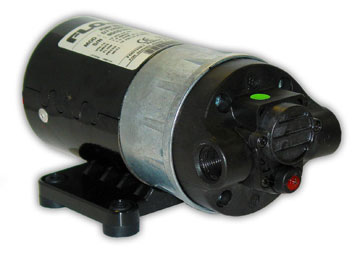
Flojet
is the other main water pump manufacturer. They are
similar to the Shurflo units. They are still big and
clunky.
2. Magnetic Piston Pump Design: Diaphragm
pumps are large, have huge NPT ports, and can be a bit
problematic, and are next to impossible to fit into
vehicles like motorcycles. It's a design fact that you
need a certain amperage, torque, and pump capacity to
fill a sink or empty a bilge.
Magnetic drive designs
isolate the pump motor from the water medium and are
exponentially more reliable than other designs. There
is no mechanical coupling of the pump and pump motor.
Companies like Aquamist
used to make magnetic drive pumps. The problem with
most magnetic drive pumps, which typically use
impellers, is that they are very low pressure units,
for the most part less than 3 psi. That certainly
won't work for forced induction applications.
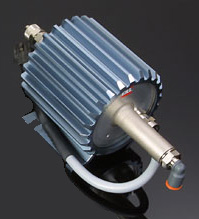
Aquamist pumps
early on, on the other hand, were quite elegant and
were magnetically driven. Aquamist had been the gold
standard for purpose-built water injection systems for
a long time. They used a small piston actuated by a
solenoid coil and were high pressure, low volume
designs due to the limited bore and stroke of the
reciprocating piston, which was surprisingly small.
They were regulated by pulsing the solenoid. If you
wanted to flow more than a certain amount of water,
about 300 ccs, you were out of luck. The volume,
beyond this point, was simply not there, the pump was
at its limit. Say you wanted to run four separate
nozzles in your manifold and two nozzles to spray your
intercooler. You run out of pump capacity. D'Oh! They
wanted you to run two of the pumps beyond this point.
The fins do look neat however. They also had nifty
ribbon charts and trim pot electronics.
Aquamist finally gave in
and went to clunky conventional Aquatech pumps...Less
than $50.00 for a big pump is too much a temptation.
3. Gear Pumps:
We researched out small 12V Gear pumps but there were
limitations in pump flow and pressure.
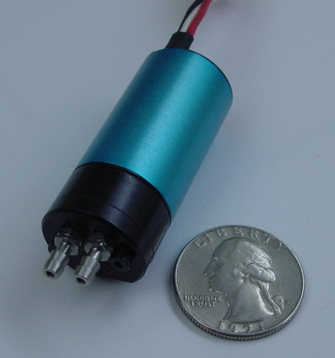
This cute little unit was rated at
500cc/minute with a pressure of 80 psi. The problem as
that it was a custom unit and the cost was $650.00
each. 80 psi wasn't enough pressure. There is always a
catch. Physical limits get in the way when you go
small, and custom design always costs money. It
required custom PEEK gear material to pump water. 80
psi was too low for proper atomization, so this was a
dead end.
Shurflo Pumps....Everyone's Solution
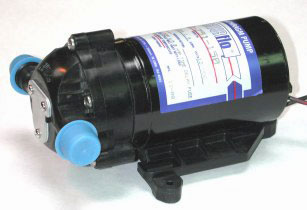
We almost signed a contract for
a large number of these units that everyone in
the water injection packaging business uses.
You buy enough of them and they are less than
$50.00 apiece. The economics seem compelling,
but we came to our senses, luckily, and
decided otherwise. We used them before and we
never were happy about the situation. They are
clunky, noisy, and heavy. Three strikes and
you're out. The Chinese even make copies of
these if you are feeling adventurous or want
to go into business selling water injection
systems.
Research...Bermuda Triangle and the
Holy Grail

Step 1: Round Up The Usual
Suspects: Commercial diaphragm pumps like
Shuflo and Flojet are pressure limited to 60 to 70 psi
(controlled by internal bypass) or 150 + psi
uncontrolled. The $900.00 Aquamist/Shurflo unit uses a
125 psi internal bypass.These pumps are big and, when
rated in gallons per minute, are way out of bounds
except for use in industrial settings as bilge pumps
or crop sprayers. Specialized Aquamist magnetic pumps
were sexy but volume impaired (300cc) by their small
reciprocating piston. Aquamist wanted you to use two
of their pumps if you need additional flow. They even
gave up on their own pumps.

Step 2: Physics 101:
We looked at all the possibilities to make the
perfect pump i.e. swash plate, diaphragm, impeller,
peristaltic, gear driven etc. and they all came up
short. Either they were pressure limited, volume
limited, or impossible to package in anything but a
large multi-pound package. Fluid is not compressible
so you need a lot of force to generate high
pressures. You need large DC motors to actuate
diaphragms, gears or pistons and the higher the
pressure the more amperage is required. No free
lunch.
Step 3: Just Do It:The
solution
was to engineer a more powerful pump that would be
small enough enough fit in the palm of your hand,
and one that would run four to six times more
pressure than the other pumps. Rubber isolation
mounts would be needed to dampen vibration. The
solution had to be a positive displacement piston
pump without diaphragms. It had to be elegant,
durable and as they say "bulletproof". Bonneville
proof.
The below was the solution we came up
with...Maybe not the best...but good enough for our
racing activities.
RSR Pro 1000 PSI
Pump...David Slays Goliath
RSR Pro 1000 PSI Pump
Advantages
Correct Flow:The RSR
Pump has the power to flow 640ccm. At 170 cc's per
minute per 300 hp you can flow enough water for most
any application. The smallest "A" nozzle flows
150ccm @ 650 psi for about 265 hp worth of water
protection. Two small "A" nozzles flow 225ccm @ 360
psi or about 400 hp worth of water protection. One
large "B" nozzle flows 285ccm @ 250 psi or about 500
hp worth of water protection.
High Pressure: The
RSR pump is rated at 650psi with the smallest "A"
nozzle flowing 150cc's/minute. RSR Nozzles deliver a
fine mist, like a fog, that will pull the maximum
heat out of your inlet charge. Even smaller nozzles
will push the pump to 1000 psi, but the flow will
cover even lower horsepower applications.
Quiet: Diaphragm
bilge pumps are noisy. The RSR Pump is very quiet,
with only a faint hum.
Small and Elegant: It
is an elegant solution that is compatible with
water, alcohol, methanol and any fuel you can think
of. Small enough for simple packaging and covering
over 530 hp @ 250psi and 300ccm. Keep in mind we
only need 170ccs for 300 hp.
Low Amperage Draw:
The RSR "Pro 1000 PSI" only draws 3 amps of power @
1000 psi. Supplied with Deutsch DTM sealed
connectors and MIL-22759/16 wire.
Durable and Long Life:
No diaphragms to fail. 1500 hrs rated for pump.
No Nozzle Leakage: No dripping of nozzles for two reasons: (1)
The pump itself acts and a check valve preventing
any flow if the pump is not running; (2) Our nozzles
have built-in check valves and filters which prevent
any siphoning in vacuum or on shut down.
Mixtures...50.50
The new pumps are alcohol and methanol
compatible . We recommend denatured (ethanol)
alcohol available in hardware, paint and Home Depot
type stores as it is not watered down like Isopropyl
alcohol and is easier to obtain than methanol. A
50/50 mix is optimum. Nothing is wrong with methanol
per se, aside from it's corrosive nature, but it's
not always easy to find. You can always dump in some
cheap isopropyl alcohol, but it's mostly water
anyway. If you are determined to run methanol you'll
find it where racing gasoline is sold and it can be
ordered over the internet. You will pay shipping and
a "Hazmat" surcharge though.
People ask us about running pure
methanol or even mixtures like 40% water and 60%
methanol. We advise against this. Volatility is the
key. Any volatile mixture will detonate at some
point...But a more important consideration is high
pressure venting around a hot engine. At Bonneville
we saw a severe fire situation in a streamliner that
was using a supposedly better engine coolant that,
when spewed out into the engine compartment, it
ignited and torched the driver's hands, helmet and
the liner's engine compartment. Keep your mixtures @
50/50.
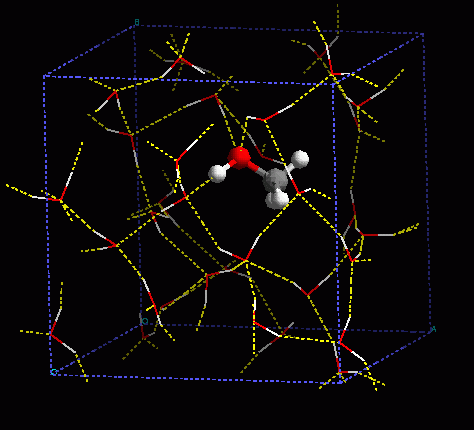
Methanol molecule CH3OH with it's
water brethren H2O. They do have an affinity for one
another.
Rocket Fuel
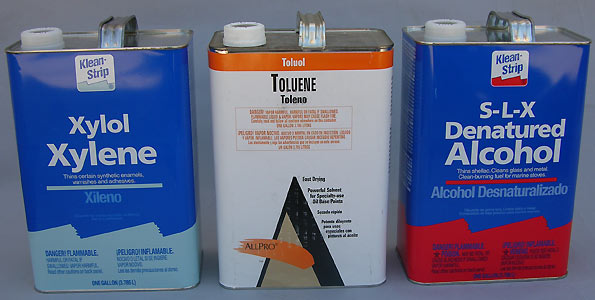
When Honda was spending 500
millions dollars a year on their V6 Formula 1
Turbo motors they ran a mixture containing 84%
Toluene (114 Octane). It has excellent
anti-detonation properties and increases your
octane rating. If you are running 92 octane pump
gasoline and you add this stuff, your octane
rating will be changed by the formula:
[(Quarts Gas x 92) + (Quarts
Toluene x 114)] / (Quarts Gasoline + Quarts
Toluene).
For example, if you add one quart
Toluene to four gallons of gasoline, your Octane
will increase onr point from 92 to 93. Add two
quarts to four gallons and you get an Octane
rating of 100. For you high boost junkies this
is something to ponder. You can buy the product
in hardware stores. Xylene has a higher
flashpoint (less volatile) and has and octane
rating of 117.
Denatured alcohol or methanol can
be added in a 50/50 mix in our water injection
systems.
Methanol Mix and Economics
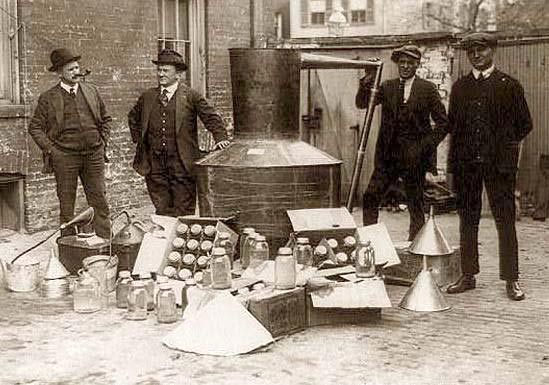
Figure out the economics. Buy a
gallon of denatured alcohol at Home Depot for
$15.00. The weight by volume is: Water 8.33 lb/gal
and alcohol 6.63 lb/gal. Water weighs 1.25 times
that of alcohol. If we mix by molecular weight and
do the math it will be 44/56 water to alcohol if
we measure volume. This is too complicated, so
let's just do two quarts of alcohol or methanol
and two quarts of water per gallon. The water is
free (more or less) so each gallon of 50/50
water/denatured alcohol will cost you $7.50
($15.00/2). If you buy a methanol mix mail order
the brew will cost you about $13.00 per gallon
with shipping.
Now if you have a race gas outlet
near you 5 gallons of Methanol will cost you
around $34.00. This brings your cost down to about
$3.40 per gallon of 50/50 mix of water/methanol.
If you have to pay shipping for the 5 gallons your
cost is going to be around $5.40 per gallon for
the 50/50 water methanol mix. Oops! there is a
$20.00 UPS Hazmat fee so that brings the cost to
$9.40 per gallon if you ship your methanol in.
In short, it's sort of silly to ship
water around, even if it is mixed with methanol or
denatured alcohol. Hey, you pay more money for
your bottled designer water so go ahead and pop
the $13.00 per gallon for the premix and shoot up
your boost juice. If you can just drive over and
buy some methanol of denatured alcohol you'll be
way ahead of the cost curve. Some race tracks sell
methanol fairly cheaply.
Hey, if you mix your own, cheat a
little and go 60% water and 40% methanol. No one
will know and you can skim the profits. It's the
American way. Mobsters used to do it...now it's
corporations and the government. Halliburton and
no-bid contracts. Hell, put in some red or blue
dye and give it a catchy name.
Millisecond Tomfoolery
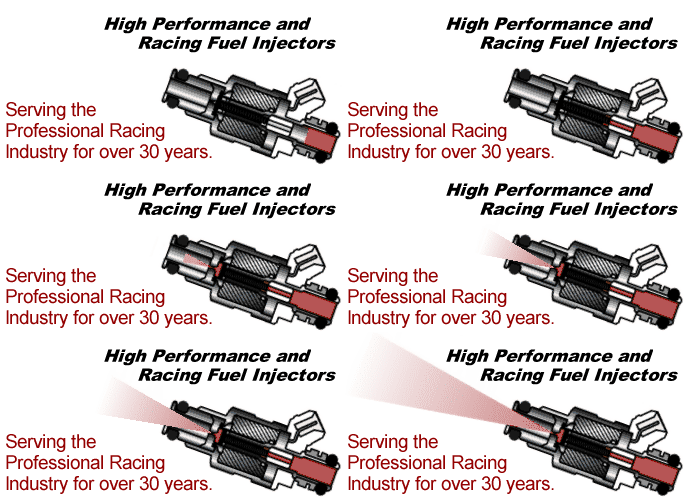
A technical point about the delivery of the
water is that we do not attempt to modulate, pulse or
otherwise try to modify the flow of the water through the
nozzles. In the late 1980's and early 1990's labor intensive
systems, where we used actual fuel injectors, the response
time of the injectors was around 1.6 milliseconds (0.0016
seconds) before linear flow could be predicted. By using
actual fuel injectors we could precisely pulse the water flow
with controllability down to a fraction of a millisecond in
this linear region. It was a very short term solution. It was
absolute in its control, but it was far from practical.
Trying to pulse non-efi solenoids is crazy as
they have very slow response times, typically around 10-15
milliseconds, or about six times slower than a fuel injector,
making the delivery of water a very "notchy" proposition.
Figure it out yourself. At 6000 rpm there is 10 milliseconds
per revolution and each four stroke cycle takes two
revolutions or 20 milliseconds. If the solenoid takes 10
milliseconds to open and a good portion of that is non-linear
then water delivery via duty cycle variation is a bit
non-linear and problematic. No one tells you this. The knobs
and trim pots they give you are very comforting however.
Another control strategy is frequency, or
voltage modulation of the pump itself. This is not a wise move
and brings an unpredictability to the situation. High end ecus
typically employ FPGAs and very high speed 32 bit processors
to control things. Not a good idea to think you are modulating
things accurately by varying duty cycles of the pump...way too
crude.
It is better to treat the water flow as a
constant flow (CIS) to pull the maximum heat out of the inlet
tract without "missing" inlet events. Treat the water
injection like an analog carburetor.
The best strategy is to size the nozzles to
provide the correct peak flow of water at the highest load and
then to taper it back to a figure of 12 to 15% of the liquid
mass entering the engine at peak rpm. This way you will know
what is happening beforehand and not twiddling some
potentiometer and not knowing what is happening downstream.
Large Industrial Check Valves in
the Lines...+/- 20% Problems
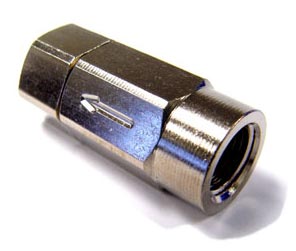
Large Industrial Check Valves, placed in the
lines, to be effective to prevent vacuum siphoning, need to
have greater than 15 psi (1 Bar) cracking pressure. A 15 to 20
psi check valve will knock exactly that much off of your
system pressure which is hurting the atomization which becomes
finer at higher pressures. If your pump is only putting out
100 psi this can be a significant variable.
One thing people do not think about is, if you
employ multiple Industrial Inline Check Valves and multiple
nozzles you are going to be dealing with two unplanned for
inconsistencies. First, some of the valves are going to leak.
They always do. Secondly, they never crack at the same
pressure and will easily "crack" at +/- 20% of the advertised
value i.e., in some situations, some will open and some won't.
We don't use them. Too many problems. Our RSR
Pumps are, in effect, check valves as will not flow when they
are not in operation. In addition we use precise nozzles with
tested cracking pressures. In that we use 450 to 1000 psi line
pressures there is no variation in single nozzle applications
and little if any variation in dual nozzle applications
Solenoids to Prevent
Siphoning...No; Control...No
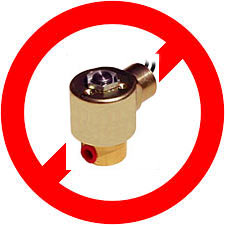
In some low pressure systems a 12VDc
bubble-tight, normally closed, solenoid with a filter can be
placed between the water pump close to the water injection
nozzle(s). When the pump is triggered the solenoid opens. This
prevents water from being sucked from the nozzles in the
higher manifold vacuum. Water dripping post shut down can
cause internal corrosion.
The solenoid insures there is no possibility of
water flowing to the nozzles unless boost is present. It also
prevents either vacuum or boost from causing either water
drainage from the lines, or boost backflow though the system.
The solenoid is normally closed and activates under the user
defined onset of water injection triggered by the pressure
activated switch.
Our 450 to 1000 psi pump acts as a check valve
itself and we use precise check valves in our nozzles so we do
not need solenoids. Another issue with these is they are
really not for water. We don't use them. You do not deadhead
1000psi.
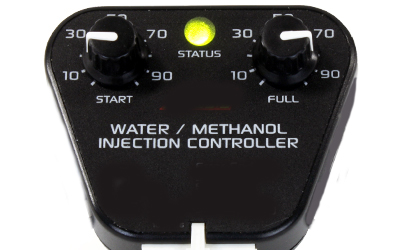
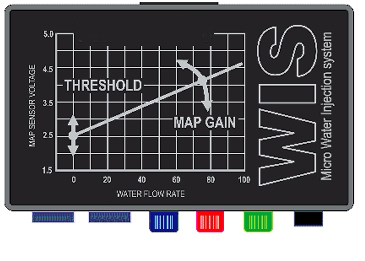
Unlike fuel injectors
which can control flow, in their linear range, to .000001
seconds (.001 millisecond), typical solenoids used for water
injection systems really only work in the 20Hz range and their
opening times are in the 10-15 millisecond range, a large
portion of which is non-linear. In short these are band-aids
and are more of a marketing device than an actual control
system. Using knobs to "control" these solenoids, which were
not designed for water in the first place, is a bit silly.
Placebos. More of a marketing device.
Upstream, Downstream, and
Orientation
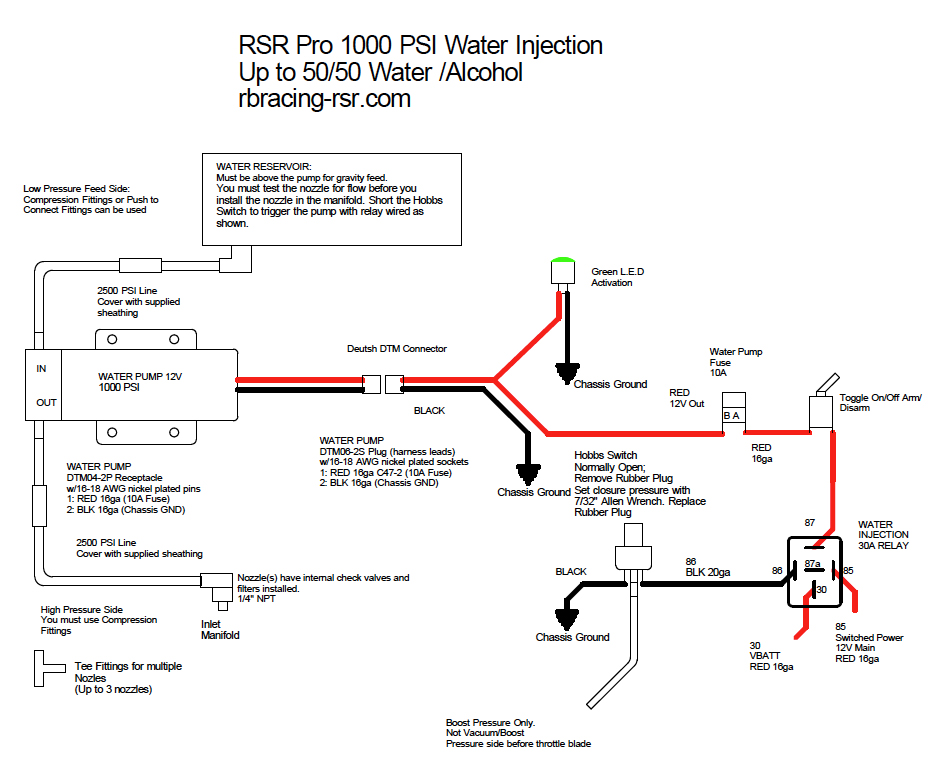
Nozzle placement is most often decided by the
architecture of the application. They can be installed in a Boost Only area
such as in the plenum or plenum runners before the throttle
body, or in a Vacuum-Boost area in the inlet tract behind the throttle body or
air metering throttle valve (butterfly). Flowing water before
the butterfly is not a good idea due to corrosion issues.
If you have a mass sensing systems of some type,
you can't inject water before the sensing element as this will
drive the hot wire or sensing element crazy. In this case you
will have to place your nozzle downstream of the butterfly in
a vacuum-boost area.
All RSR pumps are essentially a check valve for
the system and unless activated no water flow can take place.
There is zero possibility of siphoning the water from the
reservoir in a vacuum situation. Our nozzles also have
built-in checkvalves and filters.
30 Amp Relays
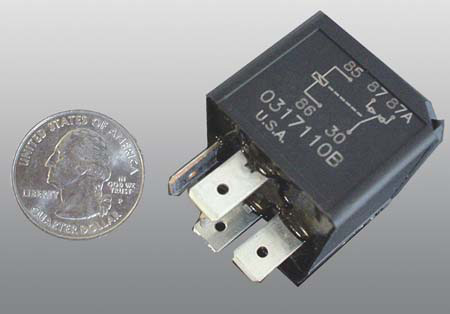
There is a logic behind how the RSR Water
Injection is hooked up and how it gets it's power, which
requires a relay. You want to be sure the water is not
activated when the engine is not running and only activated
under pre-defined boost levels.
Hobbs Boost Pressure-Activated Switches
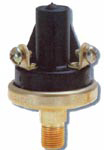
User adjustable to trigger specific water
injection events. There is usually just one of these used to
turn on the pump and open the solenoid.These are usually
referenced to plenum or boost pressure and not below the
throttle where both vacuum and boost is present. Adjustable
from .5 to 150 psi. 1/8 NPT. Water injection is best turned
on and off. Pulse width modulating agricultural pumps and
slow acting solenoids is a recipe for inaccurate water
delivery. Activate at highest load at lower rpms.
Simply set the pressure switch with a test
light, pressure gauge and either a Mityvac hand pump or
compressed air source. Use a 7/32" Allen wrench to set
pressure activation point. We use genuine Hobbs switches and
they have gotten more and more expensive as time has gone
by. Simple.
All RSR Water Injection Systems have a manual
disarm switch (on / off) that can deactivate the system.
ECU Activation
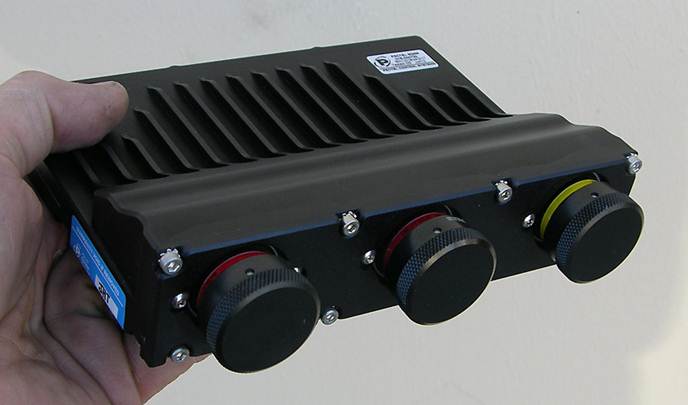
These days we use high end Cosworth SQ6M ecus with front
end FPGA's to run the calculations on when to "turn on" the
water...not some add on box with blinking lights. The SQ6M
is programmed to trigger a relay to activate the water
injection for a variety of parameters. This box is about
$7,000.00. Figure $3,000.00 for custom wiring harness and
sensors. We use them on our Bonneville and street high-end
Harley turbos.
With the SQ6M and other engine management
systems you do not need a Hobbs Switch. Some people want to
use solenoids and PWM (Pulsewidth Modulation) to control
water flow. We just use the SQ6M to turn it on with a relay
as the pulse modulation with a slow acting solenoid is a bit
problematic.
Normally Aspirated...Not Our Bag

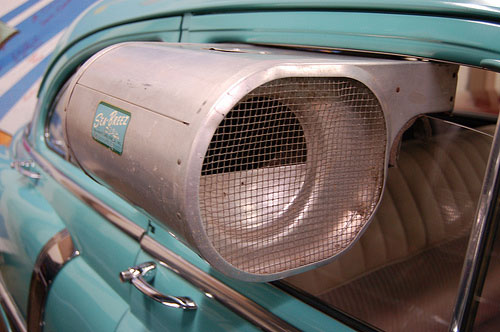
Some people want to use water injection with
non-boosted, normally aspirated engines. High desert heat,
high compression etc. This is not an area we are going to do
development in. If you choose to do so you can source vacuum
operated switches yourself to control the activation. You
are on your own in this regard. We remember the Spearco Injectronic
units way back when and even got to baby-sit George and Pat
Spears booth at a SEMA trade show once eons ago. George
dropped out of the turbo and water injection business,
ditched his previous connections with Carroll Shelby, and
went into the intercooler business which he later sold, then
retired. The engineering, nozzle, sizes and strategy is up
to you.
Some vendors promise a 5 to 15% increase in
fuel economy. They also have a big bridge for sale.
You can even rig something up to spray you if
you so choose. We're turbocharger specialists. You get to be
the other specialist whatever that is.
Digital Turbo Dashboard
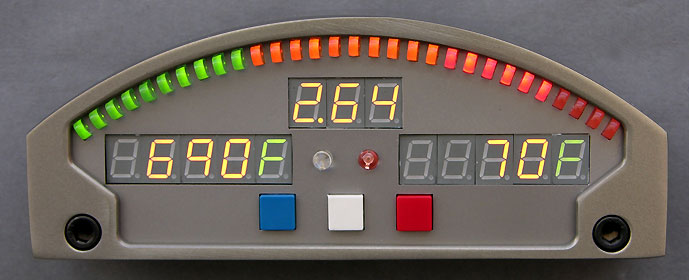
Shown here running at 2.64 Bar (24 psi) in
bright sunlight. You can read more about the ORCA Turbo Dash development.
You can also
watch a movie of the dash in operation on one of our
turbocharged Harleys.
3 Bar display with 30 leds 30"Hg to
30 PSI (3 Bar). First ten l.e.d.s are green and represent the
1.0 Bar Pressure range. The second ten l.e.d.s are orange and
represent the 2.0 Bar Pressure range. The last ten l.e.d.s are
red and represent the 3.0 Bar Pressure range. A three digit
"Bar" digital read out (0.00 to 3.00) is directly below the 30
l.e.d.s.
There are two four digit Type K
Thermocouple displays which can be used to monitor two egts or
any other temperatures like charge cooling etc. Celsius and
Fahrenheit selectable by pushing blue and red buttons
simultaneously. Last digit displays "C" or "F" in bright
green.
Two l.e.d. display lights for water
injection: Blue l.e.d. for water injection pump activation.
Three button control for the display functions: Blue: high
recall; White: display dimming function; Red: reset of high
recall. Simple, logical. Bonneville race quality.
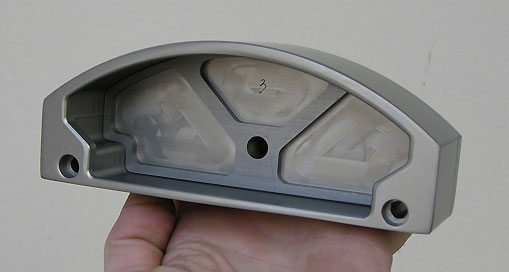
This is the most sophisticated
microprocessor based dash for turbocharger and supercharger
use. Display is only approximately 6" wide by 2.5" tall. A
total of 45 leds and three buttons. Buttons are high force,
easily activated, even wearing gloves. Hard anodized and
machined from billet enclosure. Water resistant but not
submersible.
Bench Testing Prior to
Installation
Whatever nozzle and pump combination you
choose you should bench test the system before you install
it in your vehicle. Whenever we engineer a new water
injection for one of our turbo kits we bench test the
delivery using either digital flowmeters or simple burettes
(100ml up to 2000ml). Water is not hazardous, so all you
need is a 12VDc power source and something to measure the
flow. If you don’t measure it you will never know. To
simulate boost pressure we employ a pressure regulator and a
gauge to accurately mimmick the delivery at different boost
levels.
Just flow water, and not water/alcohol, in
your testing for obvious reasons.
For you creative types you can use our nozzles
both up and downstream as well as squirting water on your
intercooler. It can get as complicated as you wish. Remember
it’s all a heat equation. Heat equals power...but too much
heat equals destruction.
Time to get cold and wet. Those nozzles make a
mess.
DIY

With probably 100 individuals and half as many
greedy capitalists gathering up parts to make "kits" pushing
water into engines it's pretty easy to check around and put
together a DIY Water Injection system for under well under
$200.00. A water pump from Northern Tool and a
bunch of parts from the hardware store and you can be a DIY
Water Injection expert. Check around. All the information is
easy to come by.
DIY people call us up all the time...which is a
huge waste of our time...i.e. telling them no... We do not
sell "Parts" so they can do all sorts of dead end scenarios
like:
1, Eight manifold nozles and 1 extra pre turbo.
2. Reservoir in front of a Porsche 911. Pump in
rear of car and six nozzles.
3. 2500hp Pro Gas methanol drag car with eight
nozzles.
4. "I have a water injection kit from Snow...I
have everything else but I want your pump"
5. "I want better fuel economy for my Cummins
Diesel semi."
Power Up

RB Racing simply can't use the generic Shurflo
systems as they just aren't suited for the motorcycle
applications and racing that we do. We tend to avoid
compromise and push the envelope. It's really a pain in the
ass to get all the details worked out, especially when you are
working with 200 mph motorcycles that have little or no space
to work with. Not everyone needs this level of sophistication
and expense. We do. Whatever you decide to do, roll your own,
or buy something, sooner or later you have to find out what
she'll do. Power that thing up and stand on it.
RSR Water Injection Calculator
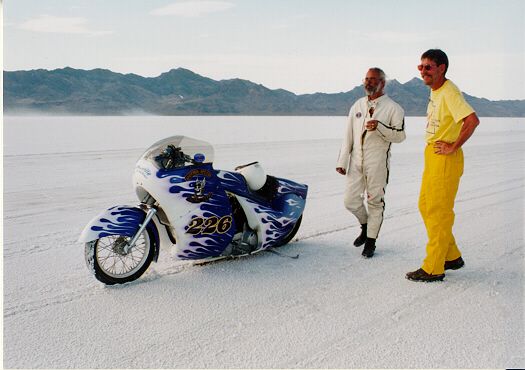
Mike Geokan's famous #226 Fuel
Injected, Water Cooled, Intercooled, Turbo Harley Davidson with
Water Injection. Bonneville record holder.
RSR Pro 1000 PSI Turbo
Water Injection Systems
RSR Water InjectionPart Number
|
CC's Minute (CCM)
|
Nozzles
|
03-1001
|
160
|
Two "B" Nozzles
|
03-1002
|
180
|
One "D" Nozzle
|
03-1003
|
180
|
Two "A" Nozzles
|
03-1004
|
200
|
Two "C" Nozzles
|
03-1005
|
210
|
Three "A" Nozzles
|
03-1006
|
240
|
Two "D" Nozzles
|
03-1007
|
260
|
One "E" Nozzle
|
03-1008
|
280
|
One "G" Nozzle
|
03-1009
|
280
|
Two "E" Nozzles
|
03-1010
|
300
|
Two "F" Nozzles
|
Water Injection
Calculator
Maximum water
delivery should be in higher load low to mid rpm ranges
tapering somewhat at peak rpms where load is less.Water or
Water / Alcohol to Fuel Ratios are between 12.5% to 25%. This
means Air to Fluid Ratios are between 11.1:1 and 10.0:1 with
water injection. Enter several horsepower figures for mid
range and peak rpms. Use our Boost
and Airflow Calculator to see what your engine requires
in boost to make a certain horsepower.
|
|
|
Bonneville and Street
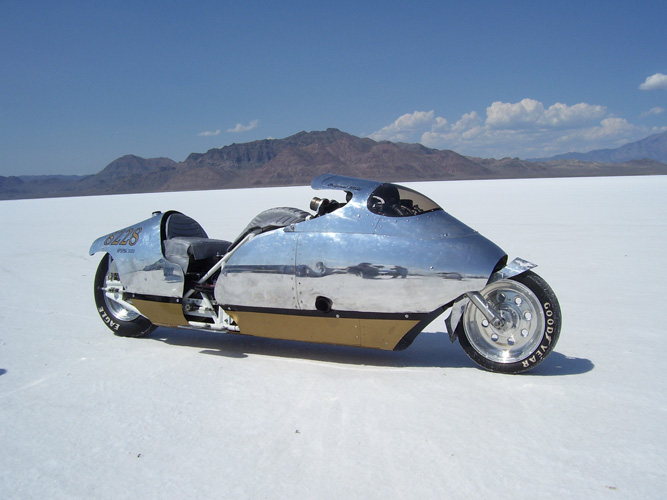
Do we actually race this
stuff? Well for the last 30 years the answer is yes.
All of our turbocharger
systems and projects
use water injection. Works for us. The bike
above at moderate 19 psi of boost and 345hp used 13%
mo;ecular weight of the water injected versus the
fuel consumed with 1000psi of nozzle pressure.
|